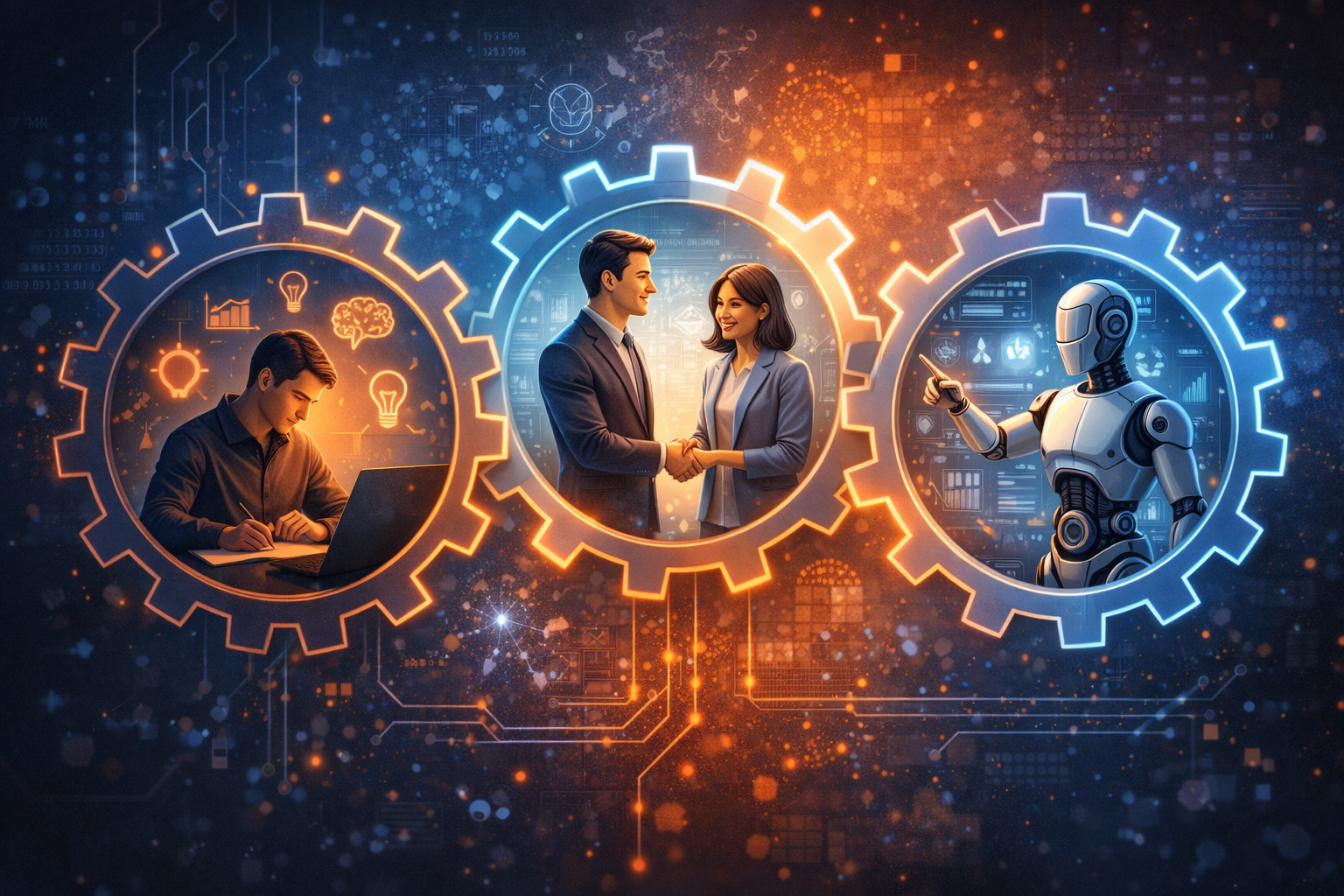
For years, we only know that there are two types of skills: Hard skill and soft skill.
Hard skill is technical ability.
Soft skill is communication and personality.
Simple…
But the world has evolved.
And (imo) that model is too simplified.
There is one question that never fit properly inside that framework.
Where does critical thinking belong?
Is it hard skill or Is it soft skill?
I think that the answer is neither.
That is why we need to adjust it to become 3: Technical, Cognitive, and Soft skills.
And here is the key shift.
What we used to call hard skill is actually two different things.
Hard skill must be separated into technical skill and cognitive skill.
Let’s define them.
Technical skill is operational.
It answers the question
What needs to be done : Coding, Designing, Running ads, Building dashboards, Executing procedures, etc
Technical skill is about jobs to be done.
You receive a task.
You execute.
You deliver.
It is structured and measurable.
Now the second layer: Cognitive skill.
This is where critical thinking belongs.
Cognitive skill answers a different question: What should be done and why
It includes : Problem Solving, Strategic thinking, Evaluating risks, Connecting ideas across domains, Questioning assumptions, etc
Technical skill works inside a system.
Cognitive skill designs and questions the system.
Technical skill solves given problems.
Cognitive skill identifies the real problem.
Technical skill executes.
Cognitive skill decides direction.
And then we have the third layer : Soft skill.
Communication.
Empathy.
Leadership.
Influence.
Negotiation.
Collaboration.
Emotional regulation.
Soft skill moves people.
You can think clearly but fail to communicate.
Your idea dies.
You can design strategy but fail to build trust.
Nothing moves.
Now here is the uncomfortable truth.
In the past, technical skill alone could secure your career.
If you mastered a tool, you had leverage.
But tools are evolving faster than humans.
And this is where AI changes the equation.
AI is extremely powerful at technical skill.
It writes code.
Generates reports.
Automates workflows.
Optimizes campaigns.
Processes data.
Follows structured logic.
AI thrives in operational tasks.
In other words, AI can solve technical skill.
But can AI define the right problem ?
Can AI sense ethical tension ?
Can AI read human dynamics in a negotiation ?
Can AI carry responsibility for consequences ?
Not Really.
AI calculates. And, Humans judge.
So if your value is only technical execution, you are competing directly with automation.
The future advantage belongs to those who combine : Technical competence, Cognitive depth, Human influence
Technical skill gets tasks done.
Cognitive skill determines which tasks matter.
Soft skill ensures alignment and execution through people.
If you only master technical skill,
you become operational labor.
If you strengthen cognitive skill,
you become strategic.
If you elevate soft skill,
you become influential.
And influence with strategy is leverage.
Machines will continue to improve in execution.
Humans must improve in interpretation and responsibility.
The real competition is not between humans and AI.
It is between humans who stay at the technical layer
and humans who rise to the cognitive and strategic layer.
I believe that the future belongs to those who think clearly,
decide wisely, and move people effectively.
